Technologies we use at Nirmitsu Design Lab
Technologies we use at Nirmitsu Design Lab
Explore Technologies
Explore Technologies
Achieve exceptional precision, and cost-effectiveness, with our world class manufacturing technologies.
Achieve exceptional precision, and cost-effectiveness, with our world class manufacturing technologies.

Fused Granulate Fabrication (FGF)
Fused Granulate Fabrication (FGF)
Best for functional parts, larger components and tooling.
Best for functional parts, larger components and tooling.
Industrial FDM printing uses high-performance thermoplastics to produce strong, precise, and durable parts for demanding industries like aerospace and automotive. It offers superior repeatability, material versatility, and scalability for functional prototypes and end-use components.
Industrial FDM printing uses high-performance thermoplastics to produce strong, precise, and durable parts for demanding industries like aerospace and automotive. It offers superior repeatability, material versatility, and scalability for functional prototypes and end-use components.
Digital Light Processing (DLP)
Digital Light Processing (DLP)
Best for fine details and suitable applications requiring efficient resin printing.
Best for fine details and suitable applications requiring efficient resin printing.
Digital Light Processing (DLP) printing uses a digital light projector to cure liquid resin layer by layer, enabling high-speed, high-precision manufacturing. It's ideal for applications requiring fine details, smooth surfaces, and strong mechanical properties, such as dental, jewellery, and engineering industries.
Digital Light Processing (DLP) printing uses a digital light projector to cure liquid resin layer by layer, enabling high-speed, high-precision manufacturing. It's ideal for applications requiring fine details, smooth surfaces, and strong mechanical properties, such as dental, jewellery, and engineering industries.
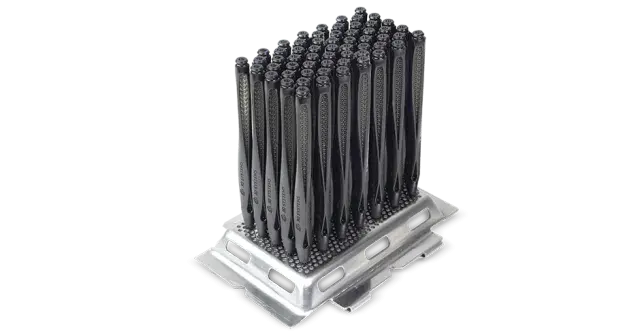
Selective Laser Sintering (SLS)
Selective Laser Sintering (SLS)
Best for complex geometries and functional polymer parts.
Best for complex geometries and functional polymer parts.
SLS technology uses a high-power laser to sinter powdered material, binding it together to create solid structures.
SLS technology uses a high-power laser to sinter powdered material, binding it together to create solid structures.

Stereolithography (SLA)
Stereolithography (SLA)
Best for detailed prototypes and smooth surface finishes.
Best for detailed prototypes and smooth surface finishes.
SLA technology uses a laser to cure liquid resin into hardened plastic.
SLA technology uses a laser to cure liquid resin into hardened plastic.

Fused Filament Fabrication(FFF)
Fused Filament Fabrication(FFF)
Best for prototyping and consumer products.
Best for prototyping and consumer products.
thermoplastic wire is melted and printed layer by layer
thermoplastic wire is melted and printed layer by layer

Know The Difference
Know The Difference
Traditional Manufacturing
Traditional Manufacturing
• Customization is expensive as it requires tooling changes
• Customization is expensive as it requires tooling changes
• Design choices are limited by tooling contraints
• Design choices are limited by tooling contraints
• High waste aiding to material inefficiency
• High waste aiding to material inefficiency
• Lead times are slow due to long setup and tooling times
• Lead times are slow due to long setup and tooling times
• Production is not flexible, only good for mass production
• Production is not flexible, only good for mass production
Additive Manufacturing
Additive Manufacturing
• Design complexity is high enabling intricate and organic shapes
• Design complexity is high enabling intricate and organic shapes
• Minimal waste aides material efficiency
• Minimal waste aides material efficiency
• Allows easy customization with cost-effective one-off production
• Allows easy customization with cost-effective one-off production
• Lead times are fast as little to no tooling is required
• Lead times are fast as little to no tooling is required
• Production is flexible, on-demand and scalable for low volumes
• Production is flexible, on-demand and scalable for low volumes

Additive vision.
Subtractive precision.
©2026 Nirmitsu.
All Rights Reserved.
Additive vision.
Subtractive precision.
©2026 Nirmitsu.
Additive vision.
Subtractive precision.
©2026 Nirmitsu.
All Rights Reserved.